Break Glass Warning – Training Guide
This guide explains why you may see the ‘Break Glass’ warning when accessing a patient record and what it means for you as a user of the system.
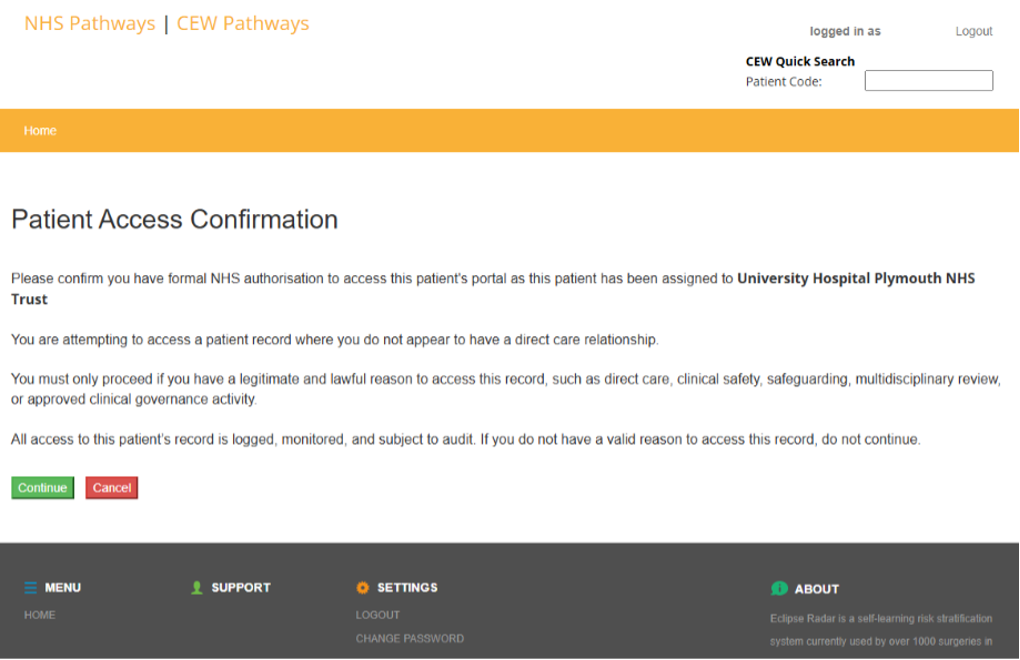
What is Break Glass Warning?
The Break Glass warning appears when you attempt to access a patient’s record, and the system does not initially detect an active direct care relationship between you and that patient, for example if they reside in a different ‘home’ clinic. It acts as a safety checkpoint to ensure that access is appropriate, justified, and lawful.
Why Might You See It?
You may see the warning in situations such as:
The patient has transferred to another clinic or service.
You are accessing the record for MDT, safeguarding, or clinical governance purposes.
You are reviewing historical information for clinical safety or follow-up clarification.
Your role does not normally involve direct clinical care for that patient.
Is This a Data Breach?
No. Seeing the Break Glass warning does not mean a breach has occurred. It is a safeguard. Access becomes inappropriate only if a user proceeds without a legitimate and lawful reason.
When Is It Appropriate to Continue?
You may continue if you have a legitimate purpose, such as:
Direct patient care or clinical decision-making.
Multidisciplinary team (MDT) discussion.
Safeguarding review.
Clinical governance, audit, or serious incident investigation.
Clarification is required for patient safety.
Your Responsibilities
All access is logged, monitored, and subject to audit. By clicking ‘Continue’, you confirm that you have a valid reason to access the record. Inappropriate access may result in investigation under NHS information governance policies.
If you do not have a clear and justifiable reason to access the record, you must select ‘Cancel’.
Key Message
The Break Glass function protects patients, clinicians, and organisations. It supports safe information sharing while reinforcing accountability and compliance with NHS Information Governance standards and the Caldicott Principles.
Tutorial Complete!